Living & visas
Retiring in Thailand: the visa, money, budget and where to settle
A warm sea all year, inexpensive fruit, good healthcare and thousands of compatriots nearby: no wonder many people choose Thailand for retirement. Here it is step by step: which visa you need, how much money to keep in the bank, how to extend the visa in Pattaya, what happens to a pension from Russia and how much it takes to live each month.
In short
- The retirement visa is for those aged 50+: 800,000 ฿ in a Thai bank, or income of at least 65,000 ฿ a month, or a combination.
- The visa is extended every year at Pattaya immigration for 1,900 ฿, and every 90 days you confirm your address for free.
- A Russian insurance pension continues abroad, and once a year you confirm that you are alive.
Which visas fit
Non-Immigrant O (retirement)
The most popular option. Requirements: age 50+ and money:
- 800,000 ฿ in a Thai bank account, or
- income of at least 65,000 ฿ a month, documented, or
- a combination of income and deposit totalling 800,000 ฿ a year.
Usually you first get a 90-day Non-O visa and then extend it for a year in Thailand. You cannot work on this visa.
Non-Immigrant O-A (long-stay retirement)
Applied for only from abroad, fee 5,000 ฿, a one-year multiple-entry visa. Besides the finances you need a police clearance, a medical certificate and insurance with cover of at least $100,000 (3 million ฿). Details in Healthcare and insurance.
Other options
- Thailand Privilege: membership from 650,000 ฿ for 5 years, with no income or insurance requirement at application.
- LTR Wealthy Pensioner: a 10-year visa with passive income of at least $80,000 a year, or at least $40,000 a year plus $250,000 invested in Thailand, including property.
All options are compared in A visa for buying property.
Extending the visa in Pattaya
The yearly extension is done at the immigration office in Jomtien, Soi 5. The fee is 1,900 ฿.
- Money in the bank. 800,000 ฿ must sit in a Thai account for 2 months before applying and 3 months after, and for the rest of the year the balance must not fall below 400,000 ฿.
- Documents. Passport, extension form, photo, a bank letter and statement, proof of address (the TM.30 notification from your landlord).
- Leaving the country. So the visa is not lost when you travel, get a re-entry permit: 1,000 ฿ for a single exit or 3,800 ฿ for multiple exits.
- Every 90 days confirm your address. It is free and can be done online at tm47.immigration.go.th. It checks your address, not your money.
A bank account
The retirement visa requires a Thai bank account. Without a long-term visa banks are reluctant to open one, which is the most common hurdle for newcomers. Banks usually ask for a passport with a visa, proof of address and a Thai phone number; requirements vary by bank and even by branch. A separate article on bank accounts is coming soon.
A pension from Russia
- The insurance pension continues when you move abroad, while the social pension stops if you move for permanent residence (per the Social Fund of Russia).
- Proof of life is needed once a year: via Gosuslugi with biometrics, at a Russian consulate or at a notary.
- How to receive it. Since 23 January 2026 the pension can be received in roubles to a Russian account. How to transfer money to Thailand legally is covered in How to transfer money to Thailand.
What it costs to live
From retirees living in Pattaya (2025–2026), the budget depends heavily on housing:
- A single retiree renting manages on roughly 35,000 roubles a month without insurance.
- A couple with their own condo and a car spends about 80,000 roubles a month, also without insurance.
- Insurance at 60–70 adds a noticeable amount: from 58,000 ฿ a year upwards, depending on the policy.
Owning a condo removes the biggest expense and protects you from seasonal rent swings. A detailed budget by category is in What it costs to live in Pattaya.
Where to live
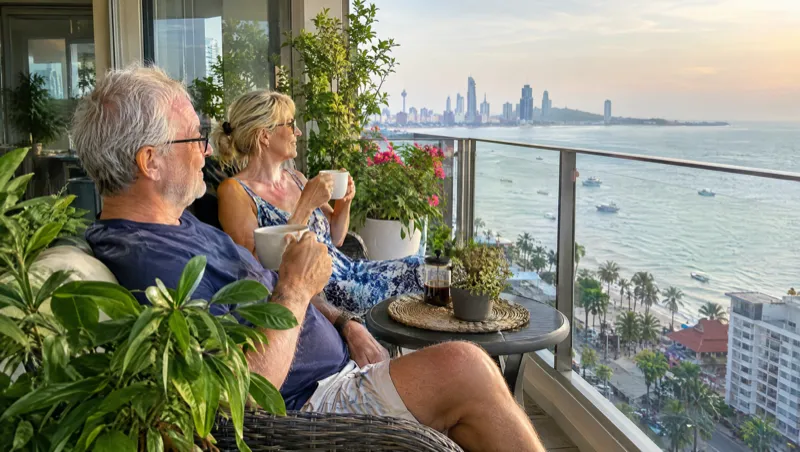
Most retirees choose:
- Jomtien: a promenade for walks, markets, hospitals and everything nearby.
- Pratumnak: a quiet green hill between the centre and Jomtien.
- Wongamat: the calm north of the city by the sea.
For retirees a lift and level paths matter, as does being close to a hospital, shops and the promenade. Compare areas in Where to live in Pattaya.
If you are thinking of a long life in Thailand
Buying a condo from 3 million ฿ gives the right to stay for up to a year, renewable, and property investments open the LTR. Separately, some developers give buyers a Thailand Privilege membership. Natalia will tell you which developers offer this and on what terms.
FAQ
How much money do I need for a Thailand retirement visa?
800,000 baht in a Thai bank, or income of at least 65,000 baht a month, or a combination totalling 800,000 baht a year. Age 50+.
How much is the retirement visa extension?
1,900 baht at the immigration office. The money must be in the account 2 months before applying and 3 months after, then not below 400,000 baht.
Is insurance required for the retirement visa?
For the O-A it is mandatory, with cover from $100,000. For a Non-O extended in Thailand there is no separate insurance requirement, but we strongly recommend it.
Does a Russian pension continue while living in Thailand?
The insurance pension continues; the social pension stops on moving for permanent residence. Once a year you must confirm you are alive.
Can I work on a retirement visa?
No, work on a retirement visa is prohibited.

Sources
- MFA Thailand: Non-Immigrant O for retirement, PDF
- MFA Thailand: Non-Immigrant O-A visa
- Thailand.go.th: retirement visa extension
- TGIA Long Stay: O-A visa insurance
- BOI: LTR Wealthy Pensioner documents, PDF
- Social Fund of Russia: pensions when living abroad (in Russian)
This article is for general information and is not legal or tax advice. Laws, fees and project terms change: before a deal we check the current conditions for the specific property.